Reduce Standing Privilege
Replace permanent access with controlled, time-bound, policy-approved access that reduces exposure.
Reduce standing privilege, control access risk, and prove identity governance across applications, databases, cloud platforms, and infrastructure.
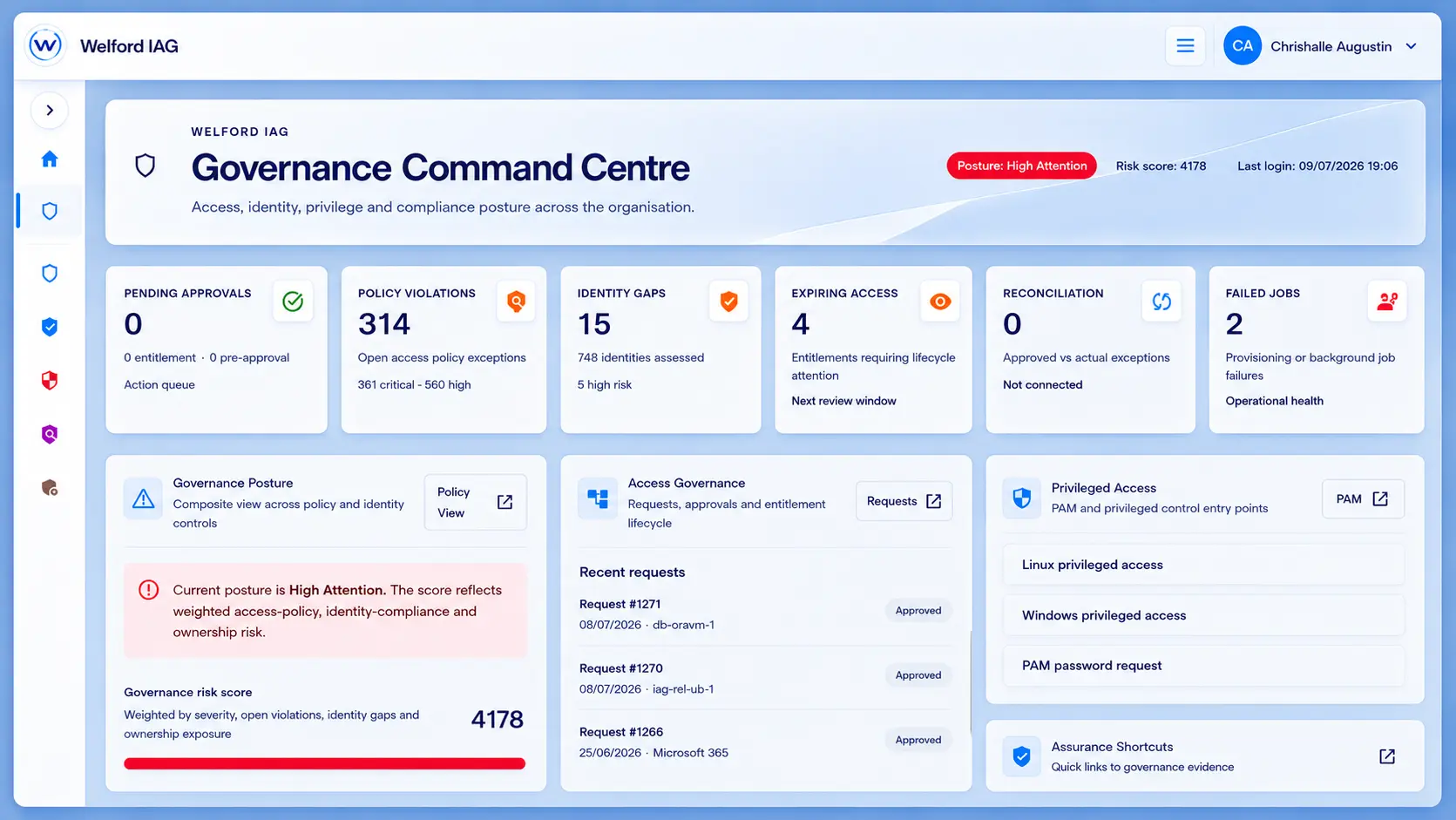
Replace permanent access with controlled, time-bound, policy-approved access that reduces exposure.
Continuously reconcile approved access against actual access across connected systems.
Automate Joiner, Mover, and Leaver access changes while maintaining business approval and audit evidence.
Govern privileged access requests, server access, elevated access, and session accountability from one platform.
Maintain a complete record of access requests, approvals, fulfilment, reconciliation, and review outcomes.
Apply configurable policies for approval routing, segregation of duties, privilege limits, duration, and compliance.
Welford IAG provides complete Identity & Access Governance for organisations that need continuous control over users, privileges, entitlements, approvals, and access evidence.
Built around Zero Trust principles, Welford IAG unifies access governance, privileged access management, identity compliance, Joiner-Mover-Leaver automation, entitlement governance, and continuous reconciliation into a single control model. Instead of relying on periodic access reviews or disconnected approval processes, Welford IAG continuously validates whether access remains appropriate, approved, secure, and compliant across enterprise applications, databases, cloud environments, Linux and Windows servers, and infrastructure platforms.
IAG controls
IAG live overview
Access reconciled
Approved access matches actual access
Privileged access requests
Time-bound approvals under control
JML actions completed
Joiner, mover, and leaver events governed
Entitlement reviews current
Ownership and certification evidence captured
Audit evidence ready
Requests, approvals, and fulfilment tracked
Every stage of the lifecycle is governed, evidenced, and audit-ready — step through the capabilities that keep IAG in continuous control.
Welford IAG enables users and administrators to request access through controlled workflows based on entitlement type, target system, business justification, risk, and policy. Approval routes can reflect business ownership, system ownership, compliance requirements, and segregation of duties.
Discover how continuous access reconciliation helps organisations reduce access drift, strengthen privileged governance, and improve audit readiness across enterprise systems.
See how Welford IAG helps your organisation control identity risk, reduce privilege exposure, and prove access governance.